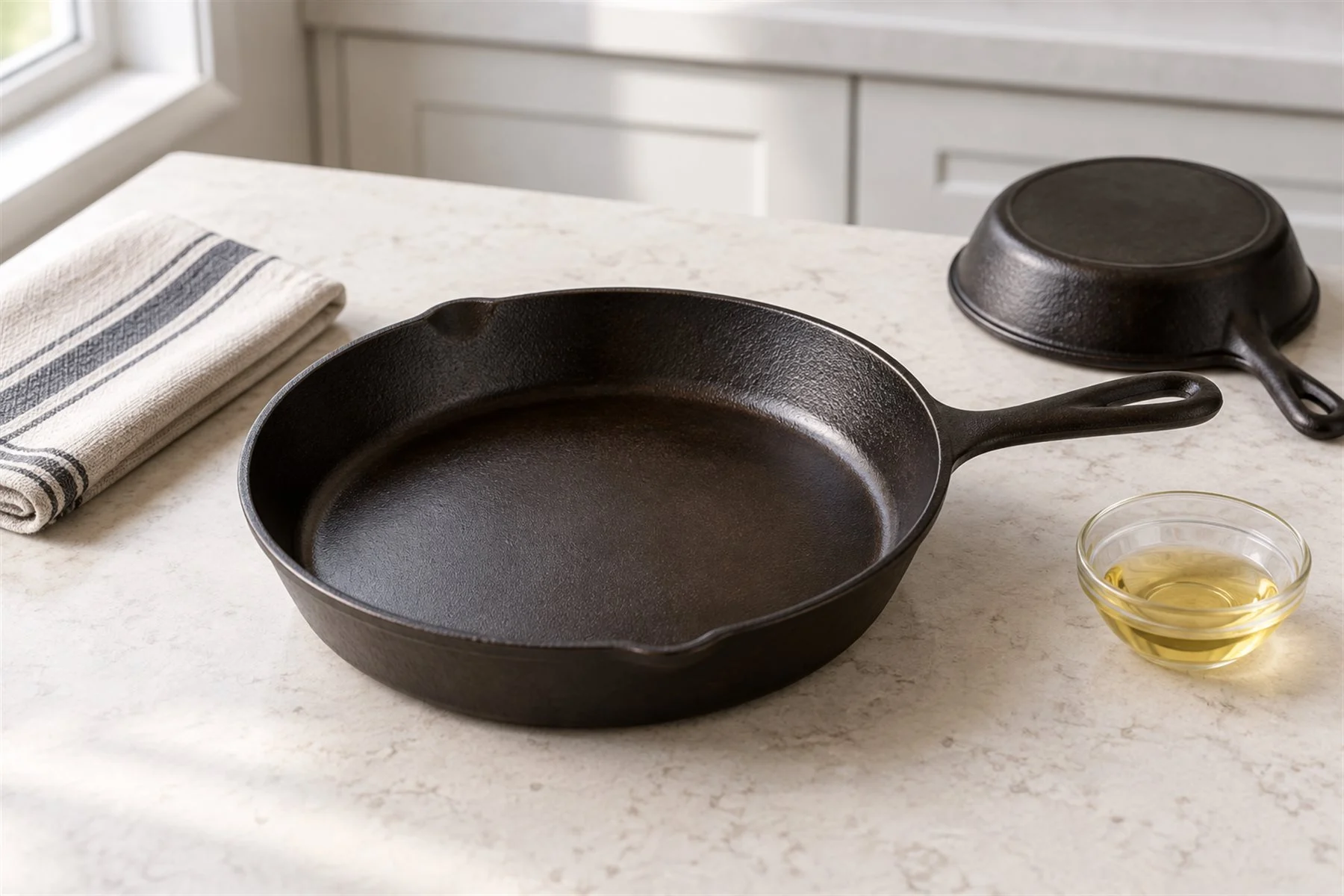
To season cast iron is to bake a very thin film of oil onto the metal until it hardens into a dark, slick coating. That coating is what protects the iron from rust and lets food release. The method is the same for skillets, griddles, Dutch ovens and their lids: wash, dry completely, oil, wipe nearly all the oil off again, and bake upside down in a hot oven for 1 hour.
The step that matters most is wiping the oil off. At 450 to 500°F, above the oil’s smoke point, a microscopically thin layer bonds to the iron as a hard finish. A thick layer cannot cure all the way through and stays sticky or bakes into blotches. Several thin coats, baked one after another, build a better surface than one heavy coat.
A new or freshly stripped pan benefits from three or four rounds. After that, ordinary cooking with a little fat keeps adding to the seasoning, and the full oven treatment is needed only when the surface looks dull, patchy or rusty. A well-seasoned pan is ready for cast iron skillet cornbread or a cast iron skillet pineapple upside-down cake.

Oven-Seasoned Cast Iron Cookware
Materials
Materials
- 1 cast iron skillet griddle, Dutch oven or other bare cast iron piece
- Dish soap hot water and a stiff brush or non-scratch scrubber
- Fine steel wool only if the pan has rust
- 1 to 2 teaspoons high-smoke-point cooking oil or fat per coat: vegetable shortening canola, grapeseed, sunflower or other refined vegetable oil
- 2 or 3 clean lint-free cloths or sturdy paper towels
- Aluminum foil or a large baking sheet to catch drips
Instructions
Wash and dry
- Set one oven rack in the middle position and another just below it. Line the lower rack with a sheet of aluminum foil or a large baking sheet. Heat the oven to 450°F.
- Wash the pan inside and out with hot water, a little dish soap and a stiff brush. If there is rust, scrub those areas with fine steel wool until bare gray metal shows, then wash again. Rinse well.
- Dry the pan thoroughly with a towel, then set it over a burner on low heat for 2 to 3 minutes, or in the heating oven for 10 minutes, until every trace of moisture has evaporated. Bare iron starts to rust within minutes if it stays damp. Let the pan cool just enough to handle safely.
Oil and bake
- Pour 1 to 2 teaspoons of oil into the warm pan. Using a cloth or paper towel, rub it over every surface: the cooking surface, the sides, the outside, the bottom and the handle.
- Take a clean, dry cloth and wipe all of the oil off again, buffing as though the oil had been applied by mistake. The pan should look dry and matte, not shiny or greasy. Enough oil stays behind in the pores of the iron.
- Place the pan upside down on the middle oven rack, above the foil. Baking it upside down prevents any excess oil from pooling on the cooking surface.
- Bake for 1 hour at 450°F. Some smoke and a hot-oil smell are normal; switch on the range hood or open a window.
- Turn the oven off and leave the pan inside, with the door closed, until it is cool enough to handle, 1 to 2 hours.
- For a new, stripped or rust-scrubbed pan, repeat the oiling, wiping and baking 2 or 3 more times, for 3 to 4 coats in all. The pan does not need to be washed between coats. The finish will darken from gray or bronze to a deep brown-black with a soft sheen.
Everyday care
- Clean the pan soon after cooking, while it is still warm. Wash it with hot water and a brush or scrubber; a small amount of dish soap does not harm cured seasoning. Loosen stuck-on food by simmering a little water in the pan for a minute, or by scrubbing with a spoonful of coarse salt.
- Do not soak the pan, leave it wet in the sink or put it in the dishwasher.
- Dry the pan with a towel right away, then warm it over low heat for a minute or two to drive off the last of the moisture.
- While the pan is still warm, rub a few drops of oil over the cooking surface and wipe it off again with a clean cloth until the surface looks dry. Store the pan in a dry place, with a paper towel between stacked pans.