Home / D.I.Y. / Pantry Staples / Homemade Chicken Stock Recipe

Homemade Chicken Stock Recipe

Two glass jars of golden homemade chicken stock with onion, carrot and celery

Homemade chicken stock turns the carcass of a roast chicken, which would otherwise be thrown away, into about 2 quarts of cooking liquid for soups, sauces, gravy and rice. The bones simmer for 3 hours with onion, carrot, celery, garlic, bay and peppercorns, and the pot needs almost no attention. Raw chicken wings work when there is no carcass on hand.

A few points decide the quality. Start with cold water and keep the pot at a bare simmer, with a bubble breaking the surface every second or two; a rolling boil churns fat and particles into the liquid and makes it cloudy and greasy. Skim the foam during the first half hour. Leave out the salt, because stock is often reduced and is easier to season in the finished dish.

The frame left from a countertop rotisserie chicken is ideal here. The 2 quarts this makes is the amount needed for chicken and dumplings soup, and it is the base for classic chicken noodle soup. Freeze it in small containers so there is always some on hand.
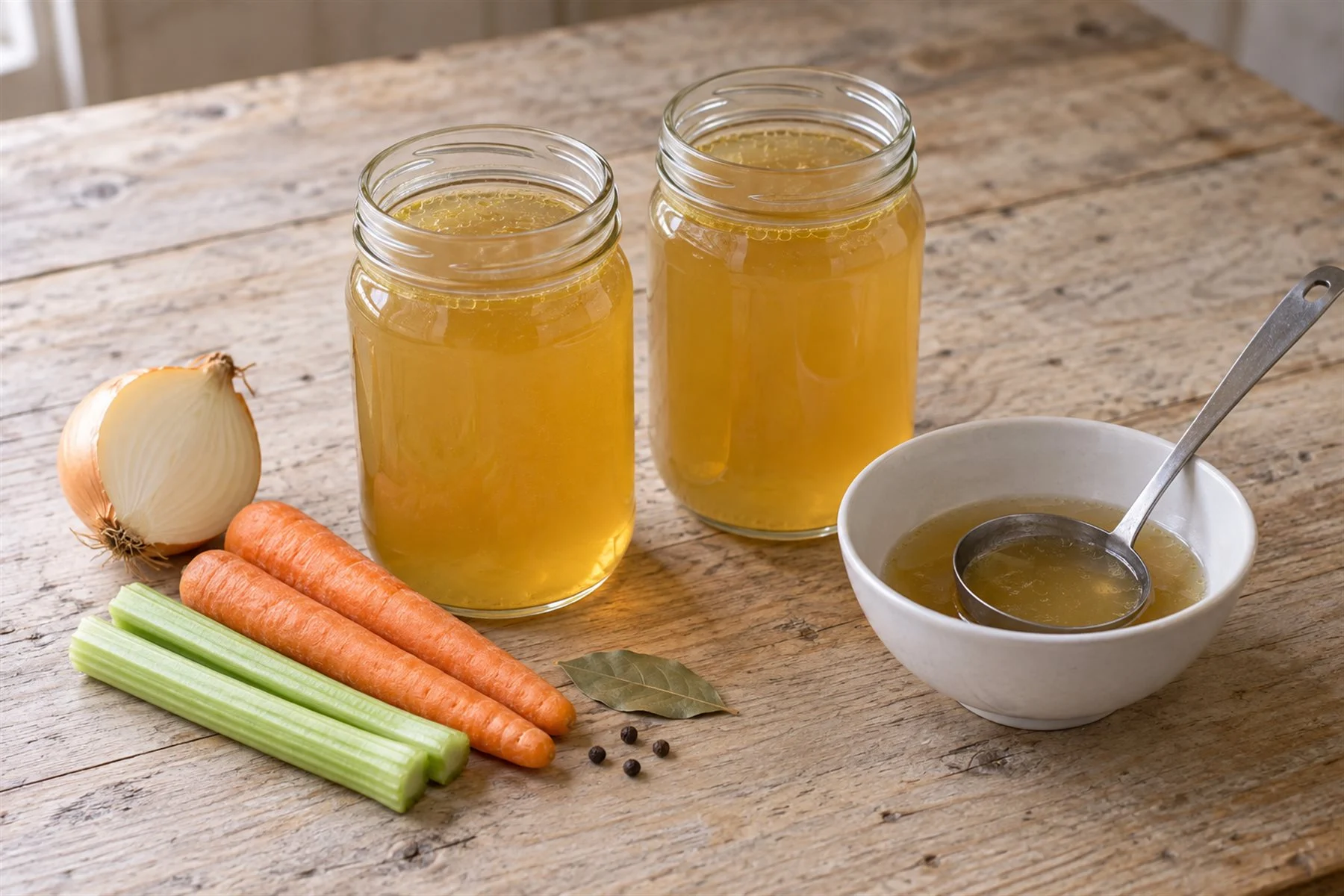
Two glass jars of golden homemade chicken stock with onion, carrot and celery

Homemade Chicken Stock

An unsalted chicken stock made by gently simmering a roast chicken carcass or wings with onion, carrot, celery, garlic, bay and peppercorns for 3 hours, then straining and cooling quickly.
Prep Time 15 minutes
Cook Time 3 hours 30 minutes
Cooling time 30 minutes
Total Time 4 hours 15 minutes
Servings: 2 quarts (about 8 cups)
Course: Pantry Staple, Soup
Cuisine: American

Ingredients
  

  • 1 carcass from a 3- to 5-pound roast chicken with any leftover skin, bones and wing tips (or 3 pounds raw chicken wings)
  • 1 large yellow onion quartered
  • 2 medium carrots scrubbed and cut into large chunks
  • 2 ribs celery cut into large chunks
  • 2 cloves garlic lightly crushed
  • 1 bay leaf
  • 8 whole black peppercorns
  • a few parsley stems or 2 sprigs fresh thyme optional
  • 3 quarts (12 cups) cold water, or enough to cover everything by about 1 inch

Method
 

  1. Break the carcass into a few pieces so it sits low in the pot. Put it in a large stockpot (6 quarts or bigger) with the onion, carrots, celery, garlic, bay leaf, peppercorns and the parsley stems or thyme, if using.
  2. Pour in the cold water; the bones and vegetables should be covered by about 1 inch.
  3. Bring the pot slowly up to a simmer over medium heat; this takes 20 to 30 minutes. As soon as small bubbles start to break the surface, turn the heat down to low.
  4. Skim off the gray foam that rises during the first 30 minutes with a large spoon or ladle and discard it.
  5. Simmer very gently, with the lid off or set ajar, for 3 hours. The surface should barely move; do not let it boil and do not stir. If the bones become exposed, add a little hot water to cover them again.
  6. Set a fine mesh strainer over a large heatproof bowl or second pot. Lift out the large bones with tongs, then ladle or pour the stock through the strainer. Discard the bones and vegetables.
  7. Cool the stock quickly: set the bowl in a sink of ice water and stir now and then until it is no longer steaming hot, about 20 to 30 minutes, or divide it among several shallow containers. Refrigerate within 2 hours of taking it off the heat.
  8. Once the stock is cold, lift off the layer of fat that has set on top, if wanted. Use the stock, or portion it and freeze.
Notes

Storage: refrigerate for up to 3 to 4 days, or freeze for up to 3 months for the best flavor. Freeze in 1- or 2-cup containers or freezer bags, leaving 1 inch of headspace for expansion. Thaw in the refrigerator and bring to a boil before using.
Food safety: do not put a large pot of hot stock straight into the refrigerator, where the center stays warm for hours. Cool it in an ice bath or shallow containers first. The carcass itself should have been refrigerated within 2 hours of the meal and used within 3 to 4 days, or frozen until there is time to make stock.
For a richer stock, collect two carcasses in the freezer and use both with the same amount of water, or add 1 pound of wings to a single carcass. Chilled stock that sets like soft jelly is a sign of plenty of gelatin from the bones and is what to aim for. With raw wings: use 3 pounds of wings in place of the carcass and proceed the same way. For a deeper color and flavor, roast the wings first at 425°F for 30 to 40 minutes until browned.
The stock is unsalted on purpose; add salt when cooking with it, starting with about 1/2 teaspoon per quart. Vegetable trimmings such as onion ends, carrot peelings, celery leaves and leek greens can replace the whole vegetables. Avoid cabbage, broccoli and other strong-tasting vegetables.
Slow cooker method: put everything in a 6-quart slow cooker and add water only up to about 1 inch below the rim, then cook on low for 8 to 10 hours. Strain and cool as above.