A wild yeast sourdough starter is a culture of the yeasts and bacteria that already live on flour, grown in a jar until it is strong enough to raise bread without any packaged yeast. This method begins with whole wheat flour and unsweetened pineapple juice for the first three days, then switches to plain flour and water.
The juice is there for its acidity, not its flavor. A new flour-and-water paste often bubbles wildly on day two and then goes flat for days, because the first bacteria to bloom stall the culture. Starting slightly acidic discourages that false start, so the sourdough yeasts establish sooner. Whole grain flour carries more wild yeast than white flour, which is why it is used at the beginning.
The quantities are deliberately small, so very little flour is thrown away while the culture gets going. Expect the process to take 7 to 14 days depending on the flour and the room temperature; 70 to 80°F is ideal. For another countertop ferment, see how to brew water kefir at home.
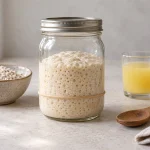
Wild Yeast Sourdough Starter
Materials
To start the culture (days 1 to 3)
- 6 tablespoons whole wheat flour or whole rye flour, used 2 tablespoons at a time
- 6 tablespoons unsweetened pineapple juice canned or bottled, at room temperature, used 2 tablespoons at a time
For the feedings (day 4 onward)
- About 4 cups 480 g unbleached all-purpose or bread flour, used 1/4 cup (30 g) per feeding
- Filtered or dechlorinated water at room temperature used 2 tablespoons (30 g) per feeding
Instructions
Day 1
- Wash a pint-size glass jar and a spoon in hot soapy water, rinse well and dry.
- In the jar, stir 2 tablespoons whole wheat flour with 2 tablespoons pineapple juice until no dry flour remains. Scrape down the sides.
- Cover the jar loosely with its lid set on top without tightening, or with a cloth held by a rubber band, so gas can escape. Keep it at room temperature, out of direct sun. Stir it vigorously once or twice more during the day.
Days 2 and 3
- Each day, add another 2 tablespoons whole wheat flour and 2 tablespoons pineapple juice to the jar. Stir well, scrape down the sides and cover loosely again.
- Stir the mixture once or twice more during each day. There may be no visible activity yet, or only a few bubbles; both are normal.
Day 4
- Stir the mixture and measure out 1/4 cup (about 60 g) of it. Throw away the rest, rinse the jar, and return the 1/4 cup to it.
- Add 1/4 cup (30 g) all-purpose or bread flour and 2 tablespoons water. Stir to a thick paste, scrape down the sides and cover loosely.
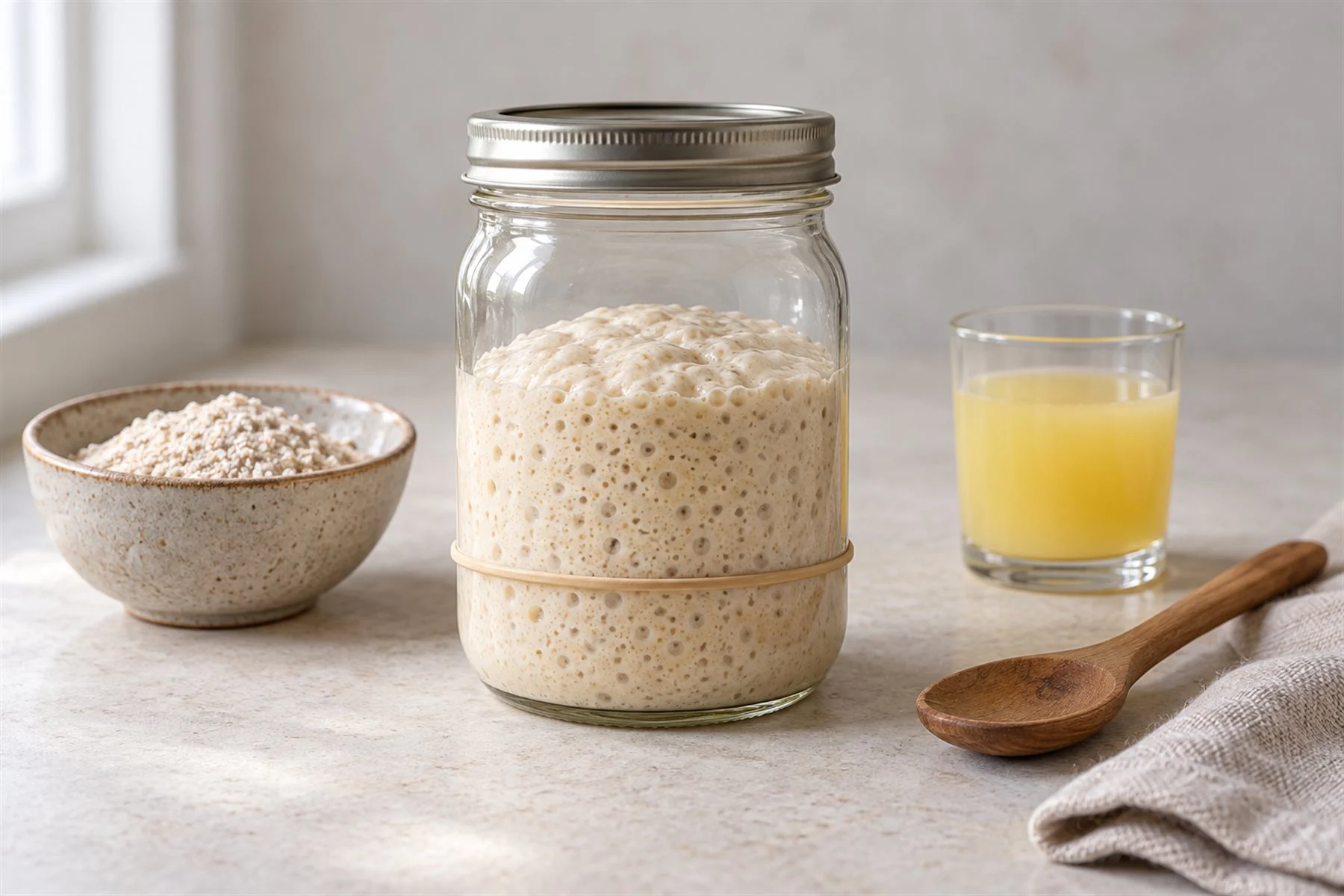
- Mark the level on the outside of the jar with a rubber band or a strip of tape so that any rise is easy to see.
Day 5 until active
- Once a day, repeat the day 4 routine: stir, keep 1/4 cup of the culture, discard the rest, and feed it with 1/4 cup (30 g) flour and 2 tablespoons water. Move the marker to the new level each time.
- When the culture starts to rise noticeably between feedings and smells pleasantly sour and yeasty, the yeast has taken hold and needs more food. From then on, feed it twice a day, about 12 hours apart, and keep only 2 tablespoons (about 30 g) of the culture each time before adding the 1/4 cup (30 g) flour and 2 tablespoons water.
- The starter is ready for baking when it reliably doubles in volume within 4 to 8 hours of a feeding, for two or three feedings in a row, and is full of bubbles all the way through. This usually happens between day 7 and day 14.
Keeping the starter
- Kept at room temperature, the starter needs feeding about every 12 hours: keep 2 tablespoons (about 30 g), discard or use the rest, and feed with 1/4 cup (30 g) flour and 2 tablespoons water.
- For occasional baking, feed the starter, let it stand at room temperature for 1 to 2 hours, then refrigerate it with the lid on loosely. Feed it at least once a week.
- Before baking, take the starter out of the refrigerator and give it one or two feedings at room temperature until it doubles again. To build a larger amount for a recipe, feed it with more flour and half that volume of water (for example 1 cup flour and 1/2 cup water) and use it when it is at its peak.