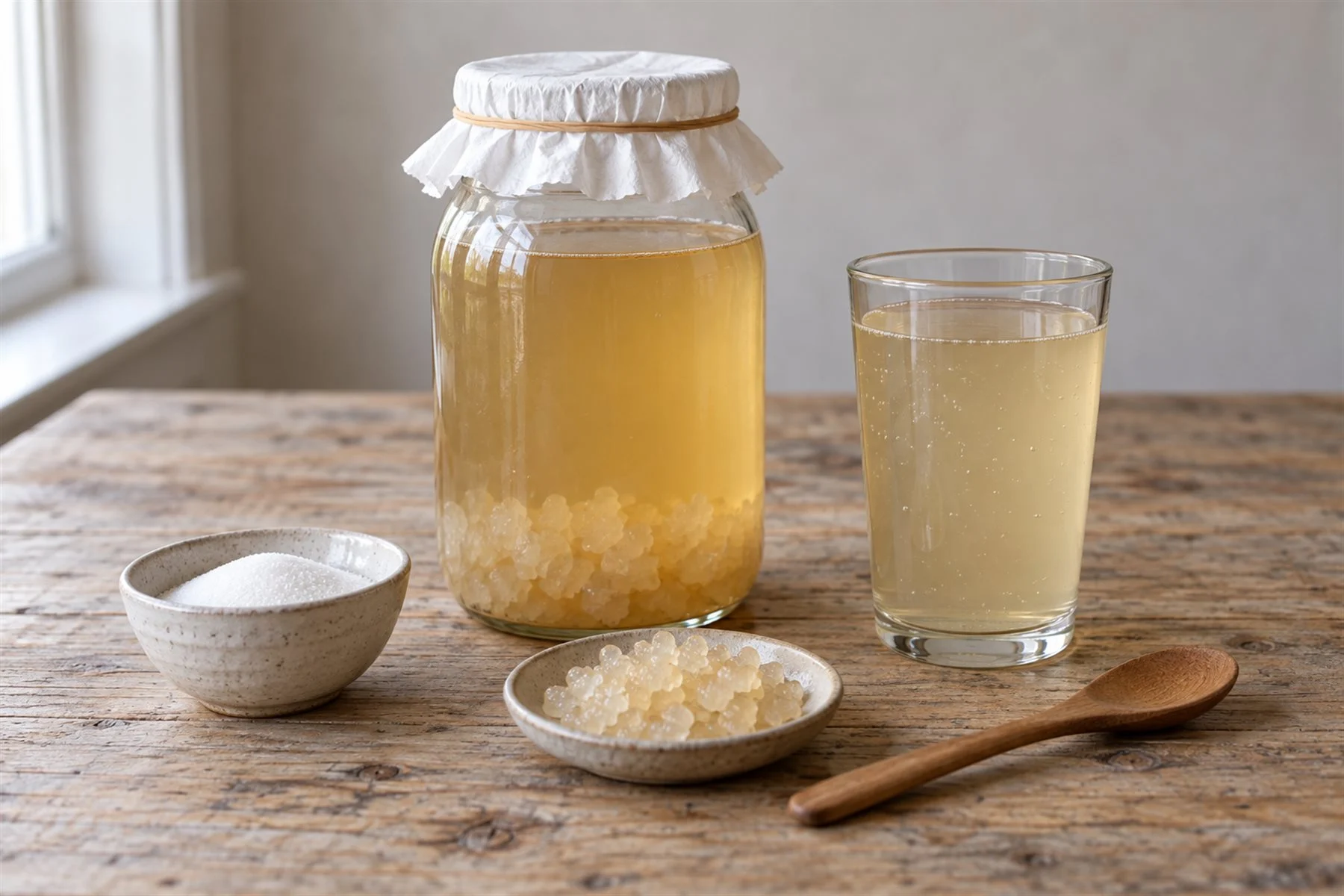
Ingredients
Method
- Pour about 1 cup of the water into a clean 1-quart glass jar, such as a mason jar, and add the sugar. Using a wooden spoon, stir until no undissolved sugar is left; slightly warm water dissolves it faster.
- Add room temperature water until the level reaches the jar's 3-cup mark. The sugar water should be at room temperature, not warm, before the grains go in.
- Stir in the molasses, along with the sea salt and baking soda if using, until everything has dissolved.
- Add the water kefir grains, then slip in the egg shell if using.
- Cover the mouth of the jar with a coffee filter or a piece of tightly woven cloth and secure it with a rubber band. Set the jar somewhere dark at room temperature, ideally 68 to 78°F, and away from the heat of the stove.
- Let it ferment for 24 hours. It is ready when it tastes clearly less sweet than the sugar water and slightly tangy. In a cool room this can take up to 48 hours, but do not leave the grains in the same sugar water any longer than that, or they start to starve and weaken.
- Pour the contents through a plastic or stainless steel strainer into a clean jar to separate the grains from the liquid. Drink the finished water kefir as it is, use it in recipes, or bottle it with fruit juice for a second ferment.
- For the next batch, make up the sugar solution again and return the reserved grains to it right away.
Notes
Makes about 3 cups. Keep finished water kefir in a closed jar in the refrigerator and drink it within about 1 week.
Sugar ratio: 1/4 cup per 3 cups of water, which is 1/3 cup per quart. Organic cane sugar and plain white sugar both work; honey is not a substitute.
Chlorine can harm the grains, so use spring, well, mineral or filtered water rather than chlorinated tap water.
Fresh grains that arrive packed in liquid should be drained and rinsed before use. Dehydrated grains can take a few batches to become active, and those first batches may be slow and only lightly fizzy.
Use glass, plastic, wood or stainless steel with the grains. Other metals, such as aluminum or copper, can react with them.
A marker line on the jar at the height of the grains shows how much they have grown by the end of the ferment.
To take a break, put the grains in a fresh batch of sugar water, cover the jar and refrigerate it for up to 2 weeks. Strain, discard that liquid and start a new batch at room temperature.
Throw out the batch, grains included, if fuzzy mold appears or it smells rotten rather than pleasantly sour and yeasty.
Like other fermented drinks, water kefir contains a small amount of alcohol, which increases the longer it ferments.
For a naturally fizzy, flavored drink, bottle the finished water kefir with fruit juice as in water kefir soda pop.